

Calcium Stearate

Calcium stearate is a calcium salt of stearic acid, a white waxy powder valued across industry for one core trait: it reduces friction and repels water at a molecular level. It works as a lubricant, release agent, heat stabilizer, and water repellent, and shows up in everything from PVC pipe manufacturing to concrete, rubber, paper, cosmetics, and food-grade applications.
Chemical Identity
Ca(C₁₈H₃₅O₂)₂ — calcium bonded to two stearate (long-chain fatty acid) groups.
1592-23-0
~607 g/mol
A metallic soap — one calcium ion bridges two stearic acid chains. The long hydrocarbon "tails" are water-repelling (hydrophobic) while the calcium-carboxylate "head" anchors the molecule to surfaces, which is what gives it both lubricating and water-repelling behavior.
Where and How It's Used
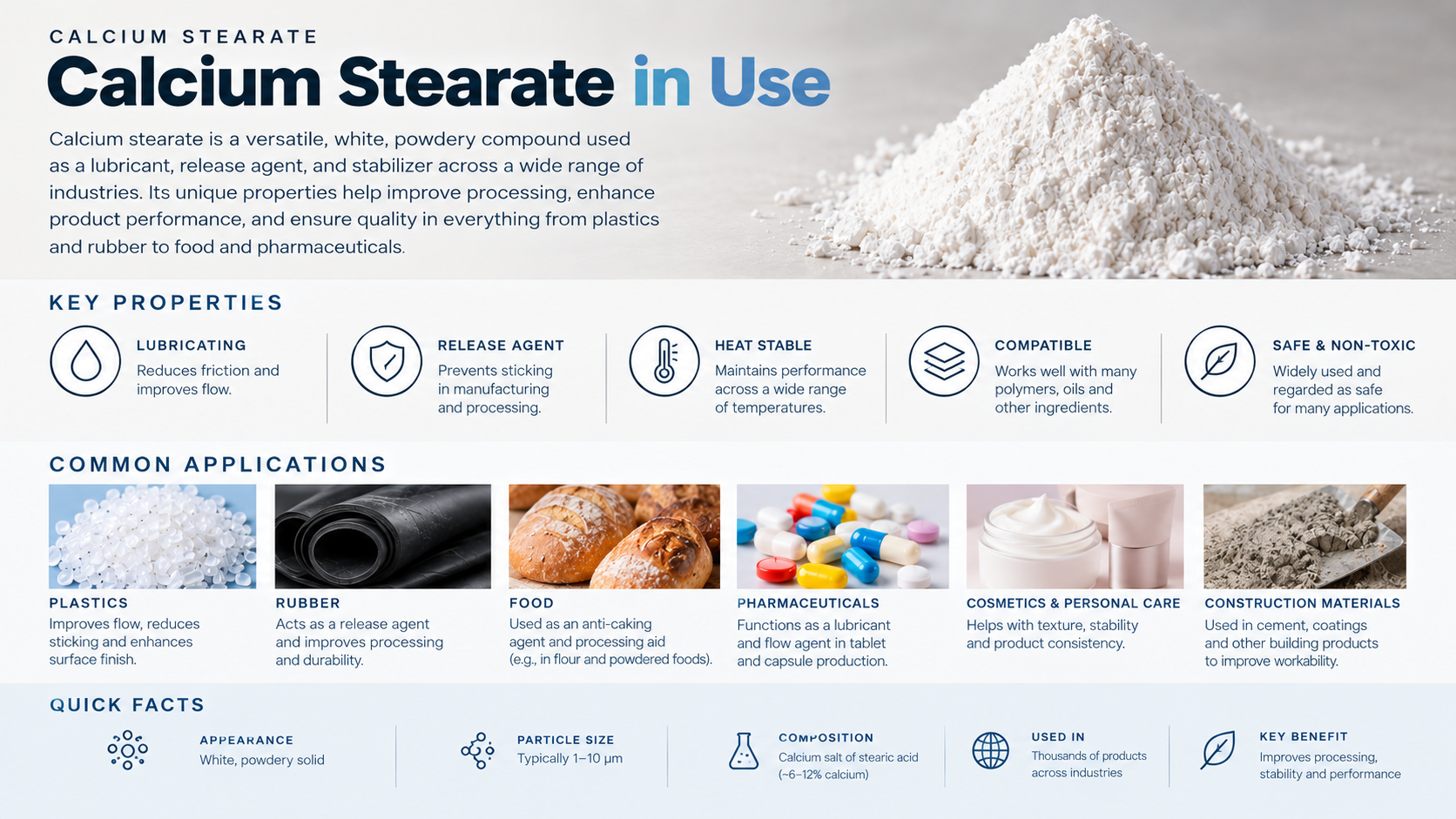
Used as a co-stabilizer alongside other heat stabilizers in rigid and flexible PVC compounding (pipes, profiles, cables). It's blended directly into the PVC resin before extrusion or molding, where it neutralizes degradation byproducts and lubricates the melt as it moves through processing equipment, giving a smoother surface finish and preventing the material from sticking to metal surfaces.
Added during rubber compounding as an internal lubricant and processing aid, helping raw rubber flow more easily through mixing and extrusion equipment and improving the release of finished rubber parts from molds.
Mixed into concrete, mortar, cement, gypsum board, and other building materials as a water-repellent additive. It coats the internal pore structure of the cured material, reducing water absorption and improving resistance to weathering, efflorescence, and freeze-thaw damage.
Applied as a coating additive to paper and packaging materials to improve water resistance, surface smoothness, and printability.
Used in powders, pressed cosmetics, and tablet manufacturing as a lubricant and anti-caking agent, helping powders flow freely and tablets release cleanly from compression molds.
Applied to mold surfaces (or blended into the compound) in rubber and plastic part manufacturing, forming a thin barrier layer that lets finished parts separate cleanly from molds without sticking or surface damage.
Handling & Safety
Generally regarded as low-hazard and not classified as a carcinogen or acutely toxic. Still handled as an industrial powder with standard precautions.
Dust mask or respirator recommended during handling to avoid inhalation of fine powder, along with gloves and eye protection.
Store in a dry, cool place away from strong oxidizers and open flame. Powder is combustible if dispersed as dust in the air, so avoid ignition sources near bulk storage.
Why It's Used
The long fatty-acid chains in calcium stearate create a slick, low-friction layer between surfaces. This is why it's added wherever material needs to move smoothly through machinery, molds, or dies without sticking or tearing.
The hydrophobic (water-repelling) hydrocarbon chains make calcium stearate an effective water repellent. When mixed into porous materials like concrete or gypsum, it coats internal surfaces and blocks water absorption.
In PVC processing, calcium stearate acts as an acid scavenger, neutralizing the hydrochloric acid released when PVC degrades under heat during manufacturing. This prevents discoloration and breakdown of the plastic during processing.
As a fine powder, calcium stearate coats other powder particles, keeping them from sticking together — used as an anti-caking and flow aid in powders, cosmetics, and pharmaceutical formulations.
Physical & Chemical Properties
White to off-white fine powder, faint characteristic odor
Insoluble in water; slightly soluble in hot organic solvents (ethanol, mineral oil)
Approximately 150°C (grade-dependent)
Typically neutral to slightly alkaline (around 7–9)
HOW WE DELIVER YOUR PRODUCT
Voptasch oversees the transportation of cargo connecting suppliers and producers with points of consumption. The Shipping and Chartering Desk at Voptasch arranges transportation issues, both for suppliers and for customers.
We are committed to delivering our customers’ products at the agreed time and in accordance with the agreed quality specifications.
Our business model relies on being able to deliver products consistently, safely and responsibly. If we were to supply off-specification products we might suffer financial penalties or find them rejected by customers.
The reputational and societal consequences could be even more significant.